

How to coordinate overlapping crew rotations?
Samantha Uribe Alonso · Published
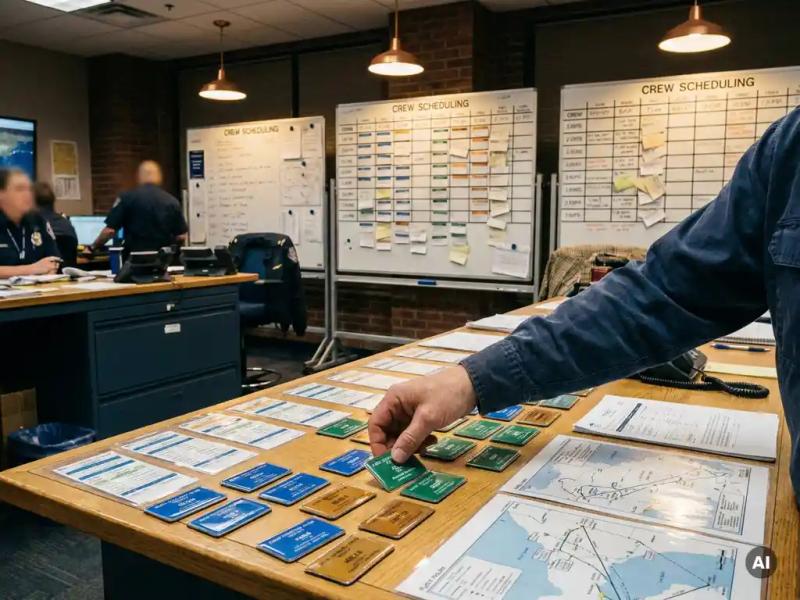
Overlapping crew rotations are one of the most demanding challenges in crew scheduling. When one team is still finishing its assignment as another is due to begin, the margin for error shrinks fast. A missed connection, a late arrival, or a booking that does not align with the handover window can leave a vessel, rig, or aircraft without the crew it needs to operate.
This guide walks you through a practical process for coordinating overlapping crew rotations, from mapping your schedule conflicts before they happen to keeping data aligned when plans change at the last minute. Follow these steps to keep your crew positioning reliable and your operations running without interruption.
Map your rotation overlaps before scheduling begins
Start every scheduling cycle by identifying where rotation periods intersect. Overlapping crew rotations become manageable when you can see them clearly before travel is booked and commitments are made. The goal at this stage is to build a complete picture of who is coming, who is going, and where the timing creates pressure.
- Pull your full roster for the upcoming period and mark the end date of each outgoing crew member’s rotation alongside the start date of each incoming replacement.
- Flag any window shorter than your standard crew change lead time – this is where overlap risk is highest.
- Group overlapping changes by location so you can see which sites or vessels are managing multiple simultaneous handovers.
- Identify crew members who are involved in back-to-back rotations, either arriving from another assignment or departing to one immediately after.
After completing this mapping exercise, you should have a clear list of high-risk overlap windows ranked by complexity. If you find three or more crew changes happening at the same location within a 24-hour window, treat that as a priority cluster requiring dedicated coordination. This foundation makes every subsequent step faster and more accurate.
Align crew travel bookings with rotation handover windows
With your overlap map in hand, the next step is to build travel bookings that respect the handover window rather than simply targeting the rotation start date. Booking to the start date alone ignores the time crew members need to travel, transfer, and be ready for duty. A crew member who lands at the same time as their rotation begins is already late.
- Work backwards from the required on-site time to determine the latest acceptable arrival time, accounting for local transfer duration and any mandatory rest period before duty.
- Use that arrival deadline to set the latest acceptable flight departure time, then book within that constraint rather than on the cheapest or most convenient option.
- For outgoing crew, confirm their departure booking does not conflict with the incoming crew’s arrival, particularly at sites where both groups require the same transport link or accommodation.
- Build a buffer into handover windows where possible, especially for locations with limited flight connectivity or known weather disruption risk.
Once bookings are aligned with handover windows rather than calendar dates alone, you will notice fewer last-minute scrambles caused by crew arriving too close to the wire. Verify each booking by checking that the confirmed arrival time sits comfortably within the handover window, not just technically within it.
Coordinate multi-crew changes happening simultaneously
Simultaneous crew changes at the same location are where coordination complexity peaks. You may be managing several outgoing crew members, several incoming replacements, shared transport legs, and limited accommodation, all at once. Without a structured approach, these situations produce conflicts that only surface when it is too late to resolve them cleanly.
Assign a single point of coordination
Designate one person as the owner of each simultaneous crew change event. This does not need to be a senior role, but it must be a clearly named individual who has visibility of all bookings, knows the handover sequence, and is reachable during the change window. Shared ownership in complex crew change management tends to produce gaps.
Sequence the handovers within the window
When multiple crew members are changing over at the same time, sequence the individual handovers rather than treating the whole event as a single block.
- List each outgoing and incoming crew pair and the specific role or position they cover.
- Determine which handovers are operationally dependent, where an incoming crew member cannot assume their role until the outgoing member has completed a specific task or briefing.
- Sequence those dependent handovers first and book travel to support that order.
- For independent roles, stagger arrivals where possible to reduce pressure on transport and accommodation at peak moments.
After sequencing, share a consolidated handover schedule with everyone involved, including travel times, transfer details, and the name of the coordination owner. If every crew member and planner is working from the same document, you eliminate the most common source of confusion during simultaneous changes.
Keep planning and travel data aligned in real time
One of the most persistent problems in crew rotation coordination is the gap between what the planning system shows and what is actually happening on the ground. A booking changes, a flight is rescheduled, or a crew member’s departure is delayed, and the planning record does not update to reflect it. That gap creates decisions based on outdated information, which compounds into larger disruptions.
- Establish a clear process for how travel changes are communicated back to the planning team. Whoever makes or receives a booking update must notify the crew planner within a defined timeframe, not at the end of the day.
- Avoid maintaining separate travel and planning records that require manual reconciliation. Where possible, use systems that share a single data source so a change in one is immediately visible in the other.
- Set a regular check-in cadence during active crew change windows, at minimum once in the morning and once in the afternoon, to confirm that planning records match confirmed travel status.
- Flag any discrepancy immediately rather than waiting to resolve it. A one-hour delay identified early is manageable; the same delay identified at boarding time is a crisis.
The verification checkpoint here is simple: at any point during an active crew change window, any member of the planning or operations team should be able to state the confirmed travel status of every crew member involved. If that is not possible, your data alignment process needs tightening.
Handle last-minute rotation changes without disruption
Even well-planned crew rotations encounter unexpected changes. A crew member falls ill, a vessel schedule shifts, or a flight is cancelled. The difference between a disruption and a crisis is how quickly and calmly the response is executed. Last-minute changes in crew scheduling are manageable when you have a clear response protocol rather than improvising under pressure.
- Maintain a short list of pre-qualified backup crew for each rotation, with their availability and certification status already confirmed. Do not start building this list when the gap appears.
- When a change occurs, immediately assess the operational impact – how long can the role remain unfilled before it affects the operation? This determines your response urgency.
- Rebook travel for the replacement crew member before communicating the change widely. Having a confirmed booking in hand makes the conversation with operations, the vessel, or the client significantly easier.
- Update the planning record at the same time as the travel change, not after. Treat them as a single action, not two separate tasks.
- Brief the incoming replacement crew member on any handover context they would normally receive from the person they are replacing, particularly if the original crew member is unavailable to provide it directly.
After executing a last-minute change, run a brief review within 24 hours. Identify what triggered the change, whether it was foreseeable, and whether the response time met your operational standard. Over time, these reviews surface patterns that allow you to reduce the frequency of last-minute disruptions through better upstream planning.
How C Teleport helps with crew rotation coordination
Following the steps above gives you a strong process framework for managing overlapping crew rotations. But the speed and accuracy of that process depend heavily on the tools behind it. Manual booking systems, disconnected data sources, and slow rebooking workflows create friction at exactly the moments when you need to move fast.
We built C Teleport specifically for operations teams managing complex, time-sensitive crew travel. Here is how the platform supports each stage of crew rotation coordination:
- Real-time booking visibility: Every booking, change, and cancellation is visible across the platform instantly, so planning and travel data stay aligned without manual reconciliation.
- Instant rebooking: When a last-minute rotation change occurs, crew travel can be cancelled and rebooked directly in the app in a couple of clicks, even on non-refundable fares within the free cancellation window.
- Access to 400+ airlines and 2.5 million+ hotels: Finding alternative routing for a replacement crew member under time pressure is far easier when you have broad inventory available in one place.
- Automated travel policies: Policy rules apply automatically at the point of booking, so planners do not need to manually check compliance during high-pressure crew change windows.
- System integrations: C Teleport connects with HR, finance, and ERP systems in under a day, so your planning tools and travel data share a single source of truth rather than requiring constant manual syncing.
- Specialist support for crew-based operations: Our marine travel solution is designed for the specific demands of crew changes at sea, where timing and connectivity constraints are particularly acute.
Whether you are managing a straightforward rotation or coordinating several simultaneous crew changes across multiple locations, our flexible travel platform gives your operations team the speed and control they need. If you have questions about how the platform works, our help centre covers the most common topics in detail.
Ready to see it in action? Book a demo and we will walk you through how C Teleport fits your crew planning workflow.
Frequently Asked Questions
How far in advance should we start mapping overlapping crew rotations?
Ideally, you should begin mapping rotation overlaps at least four to six weeks before the scheduled crew change, particularly for locations with limited flight connectivity or complex logistics. For high-traffic sites or periods with multiple simultaneous changes, extending that window to eight weeks gives you enough lead time to resolve conflicts before travel is booked. The earlier you identify pressure points, the more options you have to sequence handovers, adjust bookings, and secure backup crew without incurring premium costs.
What is the minimum buffer time we should build into a crew handover window?
The right buffer depends on your location’s connectivity and operational requirements, but as a general rule, plan for a minimum of four to six hours between a crew member’s confirmed arrival and their required on-duty time. For remote or offshore locations with a single daily transport link, extend that buffer to 24 hours where possible, since a single missed connection can cascade into a full-day delay. Factor in mandatory rest periods before duty, local transfer time, and any site-specific induction or briefing requirements when calculating your minimum.
What should we do if a backup crew member is not available when a last-minute gap appears?
If your primary backup list is exhausted, immediately escalate to your agency or crewing partner while simultaneously checking whether the outgoing crew member can extend their rotation by even 24 to 48 hours to bridge the gap. Be transparent with the vessel or site as early as possible, since operational teams can often accommodate a short extension more easily than an unmanned role. This situation is also a signal to review the depth of your backup pool — if one absence is enough to exhaust your options, your contingency planning needs expanding.
How do we manage crew certification and compliance checks during a fast-moving last-minute change?
The most effective approach is to maintain a pre-verified backup roster where certification status, medical validity, and visa eligibility are already confirmed and kept current, rather than checking these at the moment a gap appears. When a last-minute change is triggered, your first action should be to pull from that pre-cleared list rather than starting compliance checks from scratch under time pressure. If you are using a crew travel platform that integrates with your HR or ERP system, certification data should be visible alongside booking information so planners can confirm eligibility in the same workflow rather than switching between systems.
How do we keep outgoing and incoming crew from conflicting over shared transport or accommodation at the same site?
The key is to treat accommodation and transport as shared resources that need to be scheduled explicitly, not assumed to be available. When sequencing your handover plan, map out which transport legs and accommodation beds are shared between outgoing and incoming crew, and confirm that departures clear before arrivals require the same resource. Where capacity is genuinely constrained, stagger arrivals and departures by adjusting flight bookings, and flag the constraint to your coordination owner so they can manage it proactively rather than discovering the conflict on the day.
What are the most common mistakes teams make when coordinating overlapping crew rotations?
The most frequent mistake is booking travel to the rotation start date rather than working backwards from the required on-site time, which consistently produces crew arriving too late to complete a proper handover. A close second is maintaining separate planning and travel records that drift out of sync, so decisions get made on outdated information. Teams also commonly assign coordination ownership to a group rather than a named individual, which creates accountability gaps during the moments that matter most.